


Table Of Contents
What's normal in the first 90 days, what to track instead of call volume, and when a quiet phone actually signals a problem
The Optimization Hangover
You finally did it. You cleaned up the categories, added real photos instead of the stock logo, filled in every service, rewrote the business description, maybe you even brought in an agency to do it properly.
Then you waited for the phone to ring.
And... not much happened.
|
SCENARIO: A kitchen-and-bath remodeler spends three weeks going back and forth with an SEO consultant, finally gets the Google Business Profile looking sharp - real project photos, every service listed, categories cleaned up and then spends the next month refreshing the dashboard every morning before coffee, watching the call log stay just as quiet as it was before. |
If that sounds familiar, you're not alone, it's one of the most common frustrations local business owners bring to a Google Business Profile agency. Maybe a call trickled in here and there. Maybe you got a notification that your profile showed up in more searches. But the flood of new business you pictured? Still not there.
Here's the direct answer, and then we'll unpack every part of it: Google Business Profile optimization is not a switch you flip. Completing your profile doesn't instantly move you to the top of the Map Pack, and being seen more often doesn't automatically mean the phone rings more often. Google has to process your changes, your rankings can shift while it does, and even once everything settles - visibility and phone calls are two different things that don't always move together.
That doesn't mean you should just wait and hope. It means knowing what's actually normal, what to watch instead of your call log, and where the line sits between "still settling" and "something is genuinely wrong." That's what this guide walks through, including a look at what happens after optimization when the phone doesn't ring right away, and where a related issue, why GBP calls can drop suddenly even without a suspension, fits into the picture.
Quick Answer: How Long Does GBP Optimization Take to Work?
There is no official Google timeline for how long it takes a profile to rank after optimization. In practice, most local SEO professionals see initial movement within 2–6 weeks and a clearer picture of whether a strategy is working by around 60–90 days, though this varies by competition level, category, and market. Google's own commitment is narrower and more specific: according to Google's Business Profile Help documentation, edits usually take up to 10 minutes to review, but in some cases can take up to 30 days. Ranking improvement is a separate, slower, and far less predictable process than the edit approval itself.
We'll break the realistic timeline down stage by stage below but the short version is: don't judge results in week one, and don't panic if week six still looks quiet.
Why Calls May Not Increase Immediately After GBP Optimization
Several things happen in parallel after you make significant changes to your profile, and any one of them can explain a quiet phone. Most of the time it's a combination.
A. Google is still processing and evaluating your changes
When you edit hours, categories, services, description, or attributes, Google reviews those edits before they go live. Per Google's documentation on Business Profile edits, an edit can come back accepted, pending, or not approved and if Google can't confirm the accuracy of a change, it may reject it outright, which is worth checking if something you edited weeks ago still isn't showing.
|
SCENARIO: A dental practice's office manager updates the services list and business description on a Friday afternoon, expecting the new content to be live by Monday's morning rush. She checks back Monday and half the edits still show "pending" not a glitch, just Google's normal review window running its course. |
Beyond edit approval, there's a separate process where Google's local algorithm re-evaluates how your changed profile matches search queries. New categories, updated services, and revised descriptions all feed back into how Google decides which searches your business is relevant for, and that re-evaluation happens gradually, not all at once.
B. Rankings fluctuate — and that's normal, not a failure signal
It's common to see your Map Pack position move around in the days and weeks after a significant change: up for one term, down for another, different again the next day. This happens for reasons that have nothing to do with whether your optimization "worked," including Google testing the updated profile against different query variations, normal algorithmic volatility, competitors making their own changes at the same time, and seasonal or demand-based shifts.
|
SCENARIO: An HVAC company owner checks his ranking for "AC repair near me" every Monday and Friday. Week one: #3 on Monday, #7 on Friday. Week two: #5, then #2. He assumes something is broken. Nothing is — this is what normal local-pack noise looks like while Google settles a profile after real changes. |
One or two weeks of choppy rankings isn't evidence something went wrong. A consistent downward trend that holds for a month or more is a different story, covered later in "When You Should Actually Worry."
C. Visibility does not equal phone calls
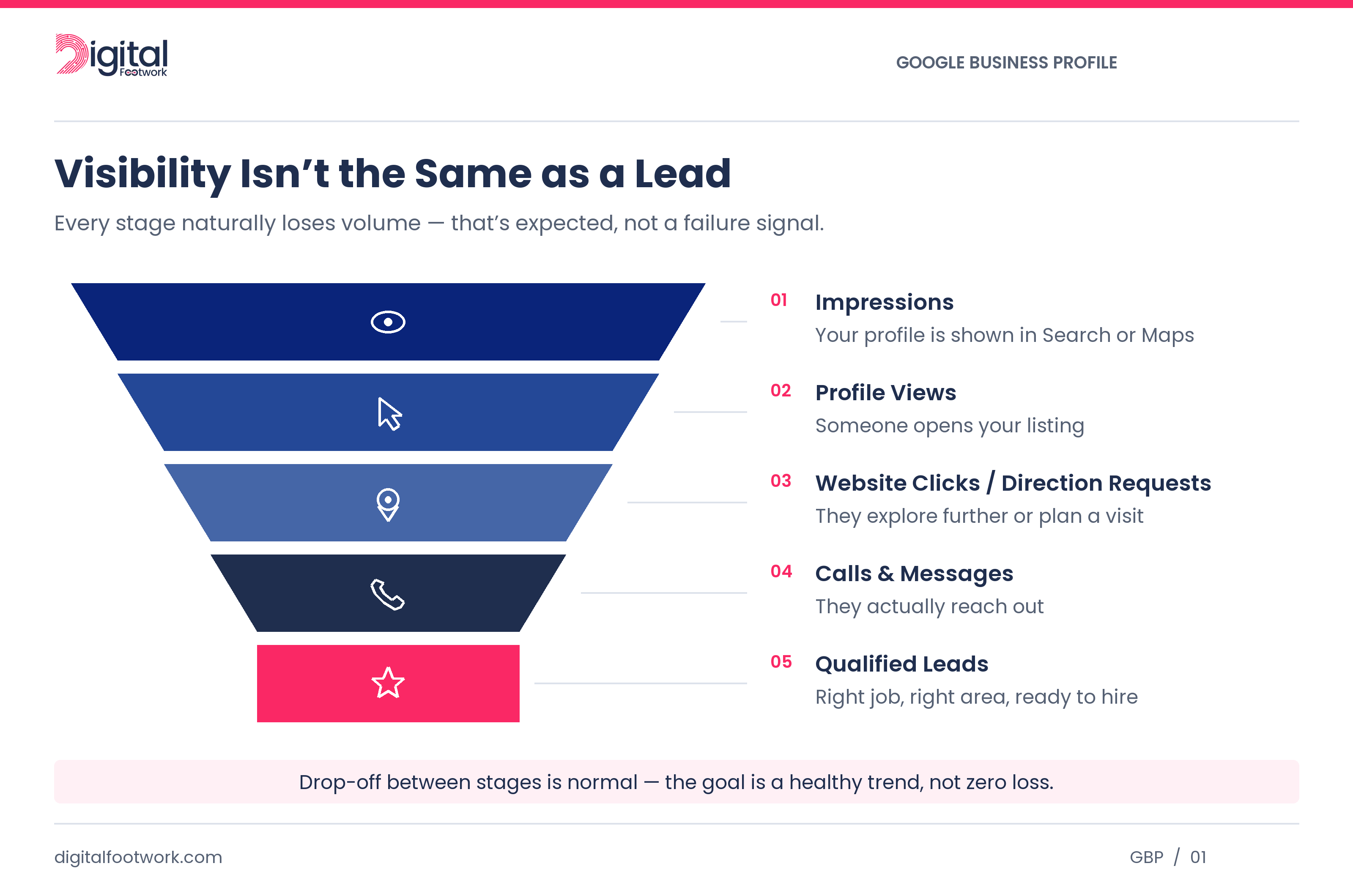
This is the distinction that trips up more business owners than anything else, so it's worth sitting with. A completed, well-optimized profile can absolutely increase how often you're shown. That's a different metric from how often someone calls. Between those two points sits a chain of decisions, impressions, profile views, website clicks or direction requests, calls or messages, and finally a qualified lead. Growth at the top of that chain doesn't guarantee growth at the bottom.
Every stage of the GBP conversion funnel naturally loses volume — that's expected, not evidence that optimization failed.
D. Search intent matters
Not everyone who finds your profile is ready to hire someone. Someone searching "how much does a water heater replacement cost" is gathering information. Someone searching "emergency plumber near me" is ready to call right now.
|
SCENARIO: A family law attorney's GBP starts showing up for "how much does a divorce cost in [city]" alongside her target term, "divorce attorney near me." Impressions climb nicely. Calls barely move — because most of that new traffic is still in the research phase, not ready to retain anyone yet. |
Your profile can rank well and get discovered by plenty of informational searchers without a proportional bump in calls, simply because informational and commercial searches convert at very different rates. That's a normal feature of local search behavior, not a flaw in your profile.
E. Competition matters — optimization isn't a guarantee of a top-three spot
A fully, correctly optimized profile is table stakes, not a finish line. Google states plainly in its own guidance on local ranking that local results are based mainly on relevance, distance, and prominence, and that a combination of these factors helps find the best match for a search. Optimization strengthens your relevance, it does very little for distance, and only some of the work for prominence, which is built through reviews, citations, and reputation over time, much of it off your profile entirely.
|
SCENARIO: A second-generation, family-owned HVAC company finally gets its GBP fully optimized — and is still outranked by a regional franchise with 40 locations, 800+ reviews, and a decade of citations and press mentions across the metro. The optimization was necessary. It just wasn't sufficient against that kind of accumulated prominence. |
No agency or checklist can promise a top-three Map Pack position, and it's worth being skeptical of anyone who does.
What Actually Happens After Major GBP Changes: The 90-Day Reality
There's no Google-confirmed rule that results arrive on day 30, 60, or 90. Treat the framework below as a realistic pattern many local SEO practitioners observe, not a guarantee. For context, Google's own guidelines for representing your business note that changes to your info can take up to three days to appear in search results, and that ranking for an entirely new business can take up to a month to show up at all — both useful anchors for setting realistic expectations.
A realistic pattern many local SEO practitioners observe — not an official Google guarantee.
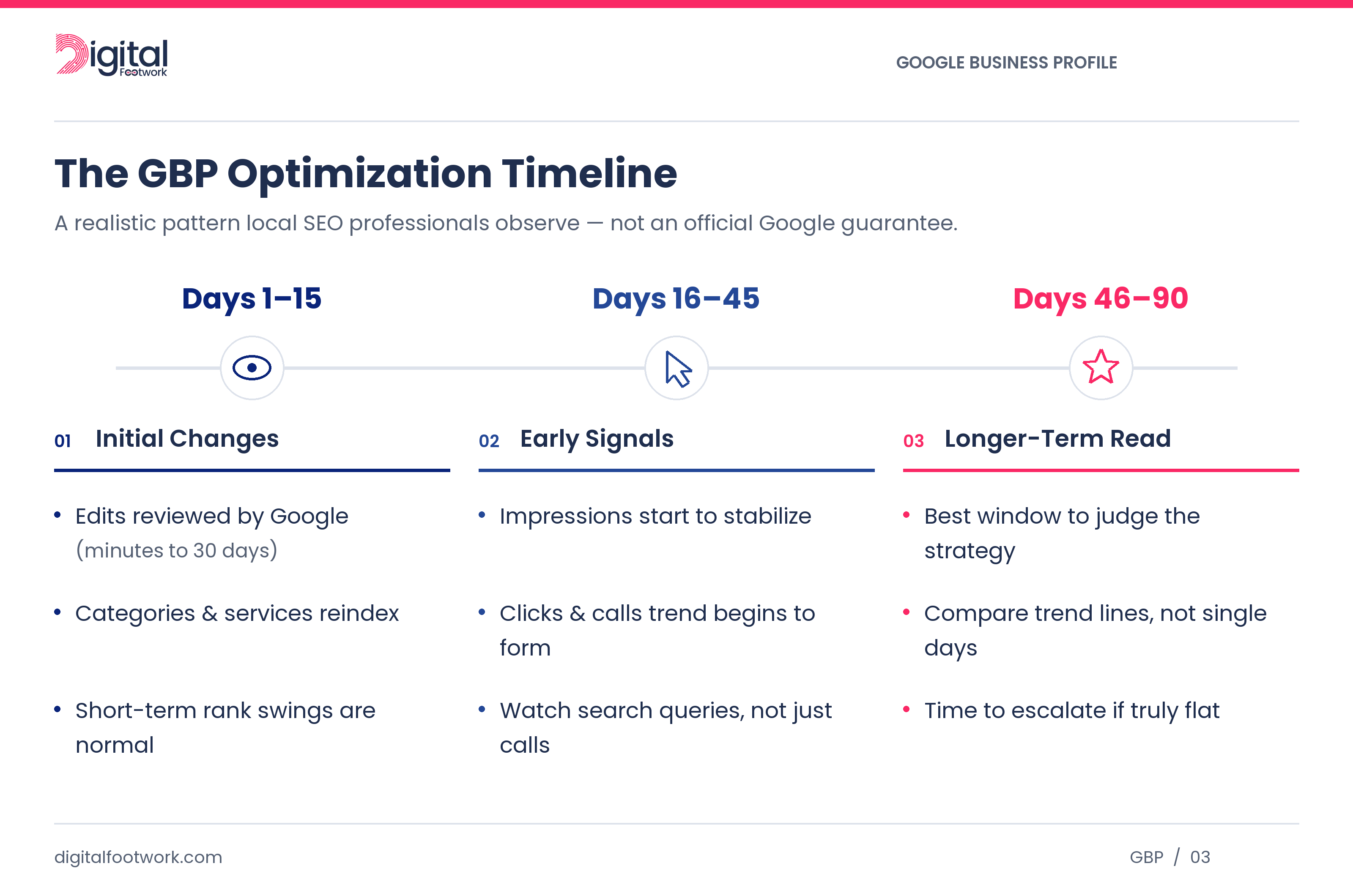
Days 1–15: Initial Changes
This is the processing window. Edits are being reviewed, and category and service changes start feeding into how Google matches your profile to searches. Don't be surprised by ranking swings in either direction, this stage is noisy by nature, and it's too early to draw conclusions from it.
Days 16–45: Early Signal & Visibility Monitoring
Start watching your Business Profile Performance data rather than your phone. Look for early movement in impressions, discovery searches, and website clicks. Calls may start ticking up here, but a slower start doesn't mean failure, it means you're early in a process that typically plays out over months, not days.
Days 46–90: Longer-Term Evaluation
By this window you should have enough data to judge trend direction, not just single-day snapshots.
|
SCENARIO: A single-location roofer in a mid-size suburb sees a clear upward call trend by day 40. Across town, a personal injury attorney working the same 90-day framework is still waiting for meaningful movement, not because anything is wrong, but because "injury lawyer" in a metro with a dozen billboard-advertising firms is a fundamentally slower, more competitive climb than "roofer near me" in a single suburb. |
Treat 90 days as a reasonable checkpoint for evaluation, not a deadline for success.
What the Research Actually Shows
It helps to ground all of this in something more concrete than anecdote. A few figures from published, credible industry research consistently show up when you look at what actually drives local search performance:
|
Finding |
Source |
|
Google Business Profile signals account for roughly 32% of local pack ranking factors, more than any other single category — and primary category selection is the single most influential individual factor measured. |
Whitespark, Local Search Ranking Factors survey |
|
Review signals (count, recency, and sentiment) account for roughly 20% of local pack ranking weight, up from prior years. |
Whitespark, Local Search Ranking Factors survey |
|
88% of consumers say they trust online reviews as much as a personal recommendation from someone they know. |
BrightLocal, Local Consumer Review Survey |
|
A large share of consumers consider reviews older than about three months to be no longer relevant when judging a business today. |
BrightLocal, Local Consumer Review Survey |
|
Edits to business info can take up to 3 days to appear in search results; a new business's ranking can take up to a month to show up at all. |
Google, Guidelines for representing your business |
Two things stand out. First, your primary category carries outsized weight, it's worth double-checking that it's still the most specific, accurate option available, not a broad catch-all chosen years ago. Second, review recency matters as much as review volume: a business sitting on 80 reviews from three years ago is working with a weaker trust signal than a newer business actively collecting fresh ones, according to the Local Search Ranking Factors survey from Whitespark.
A pattern worth naming here, drawn from how these dynamics typically play out rather than any single verified case: businesses that pair a genuinely optimized profile with a steady drip of new reviews, even just two or three a month, tend to see conversion metrics move meaningfully faster than businesses that optimize once and then go quiet. The profile work opens the door; the review velocity is often what gets someone to actually walk through it.
Why Visibility Doesn't Always Equal Calls
It's worth expanding on the funnel introduced earlier, because it's the single most useful mental model for interpreting your GBP data without panicking. Every stage naturally loses volume. That's expected, not evidence that your optimization failed.
What matters more than hitting any industry average is your own trend over time. If impressions and views are climbing steadily but calls are flat, the fix usually lives lower in the funnel, trust signals, review recency, response speed, or the experience once someone clicks through to your website, not "more optimization" higher up. If impressions themselves are flat or falling, that's a visibility problem, and the fix belongs back in the profile and local ranking work.
What Metrics You Should Track (Instead of Obsessing Over Daily Calls)
Watching your call log day to day is one of the least reliable ways to judge whether your GBP strategy is working - call volume for any small business is naturally lumpy. Instead, track these on a rolling basis using your Business Profile Performance dashboard:
|
Metric |
What it tells you |
|
Impressions / views |
Whether Google is showing your profile more |
|
Search queries |
Whether you're appearing for the right searches, not just more searches |
|
Website clicks |
Whether interested viewers are exploring further |
|
Direction requests |
Local intent — people planning to visit or expecting you nearby |
|
Calls & messages |
Direct contact volume |
|
Review growth & recency |
Trust signals building (or quietly going stale) |
|
Local rankings |
Position for your priority search terms |
|
Website organic traffic |
Whether your broader local SEO is gaining ground |
|
Lead quality |
Whether the calls/forms coming in are a good fit, not just numerous |
A business can see calls hold steady while impressions and reviews quietly decline, a warning sign hiding behind a metric that still looks fine today. Or the reverse: calls dip for a week while every underlying signal is trending up, which usually means the calls are coming, just not yet.
How to Increase Calls and Conversions From Your Google Business Profile
If you've been through a full optimization cycle and calls are still lower than expected, work through these in order.
1. Improve your website's conversion experience
Many "GBP problems" are actually website problems in disguise. Someone clicks through from your profile, lands on a slow or confusing page, and leaves without calling. Check for a visible, tappable click-to-call button (especially above the fold on mobile), service pages that match your GBP services section, fast load times, and basic trust elements, reviews, licensing, before/after photos, clear service-area language.
2. Publish useful GBP content regularly
Google Business Profile updates (posts) keep your listing active and give searchers a reason to engage further. Posts aren't a confirmed direct ranking factor on their own, but consistent, genuinely useful ones — finished jobs, seasonal reminders, answers to common questions, tend to increase profile engagement, which supports the broader signals Google does weigh. If keeping a steady content cadence isn't realistic in-house, this is exactly the kind of recurring work that content creation services are built for and it pairs naturally with the repeatable content system many service businesses use to keep both their website and profile active without reinventing the wheel every month.
3. Build legitimate reviews — the right way
Reviews are one of the strongest trust signals on your profile, and also one of the easiest places to get in trouble. Google's own Maps content policy on fake engagement is explicit: content posted because of an incentive, payment, discounts, or free goods or services — is not permitted and will be removed, and selectively soliciting only positive reviews ("review gating") is a violation too.
|
SCENARIO: A boutique auto shop starts offering a $10 discount for anyone who leaves a Google review. Review volume jumps for a month. Then several reviews disappear, a policy warning shows up on the profile, and new reviews get temporarily restricted — a costly way to learn that incentivized reviews aren't a shortcut, they're a liability. |
- Ask every customer, not just the ones you're confident were happy — selective solicitation is itself a policy violation
- Make the ask simple: a direct link sent right after the job is done
- Never offer a discount, gift, or incentive of any kind for a review
- Never script exact wording, keywords, or location terms for a customer to use
- Respond to every review, positive and negative, professionally and promptly
4. Improve service relevance across your entire presence
Your primary category, secondary categories, listed services, and website service pages all need to tell the same story. If your primary category is "Plumber" but your website is built entirely around "drain cleaning," that mismatch weakens relevance in both directions. Audit these four together, not separately.
5. Improve local authority the legitimate way
Prominence is built off-profile as much as on it: accurate, consistent citations across major directories, genuine local links from sponsorships or press, real community involvement, and location-specific content on your website that actually helps local searchers. This is slower, compounding work, which is exactly why the businesses that treat it as an ongoing system, rather than a one-time push, tend to pull ahead over a year rather than a quarter.
6. Review what your actual competitors are doing
Pull up the Map Pack for your priority search terms and look honestly at who's outranking you, review count and recency, categories used, how complete their profile looks. This isn't about copying anyone; it's about understanding what "competitive" looks like in your specific market before assuming your own profile is the problem.
Diagnose Your GBP Performance
Rather than working down a generic checklist, it's usually faster to start by placing yourself on two axes: how visible you are (impressions, rankings) and how well that visibility is converting (calls, messages). Where you land points to a different fix.
Match what you're seeing in your own data to the most likely cause before assuming something is broken.
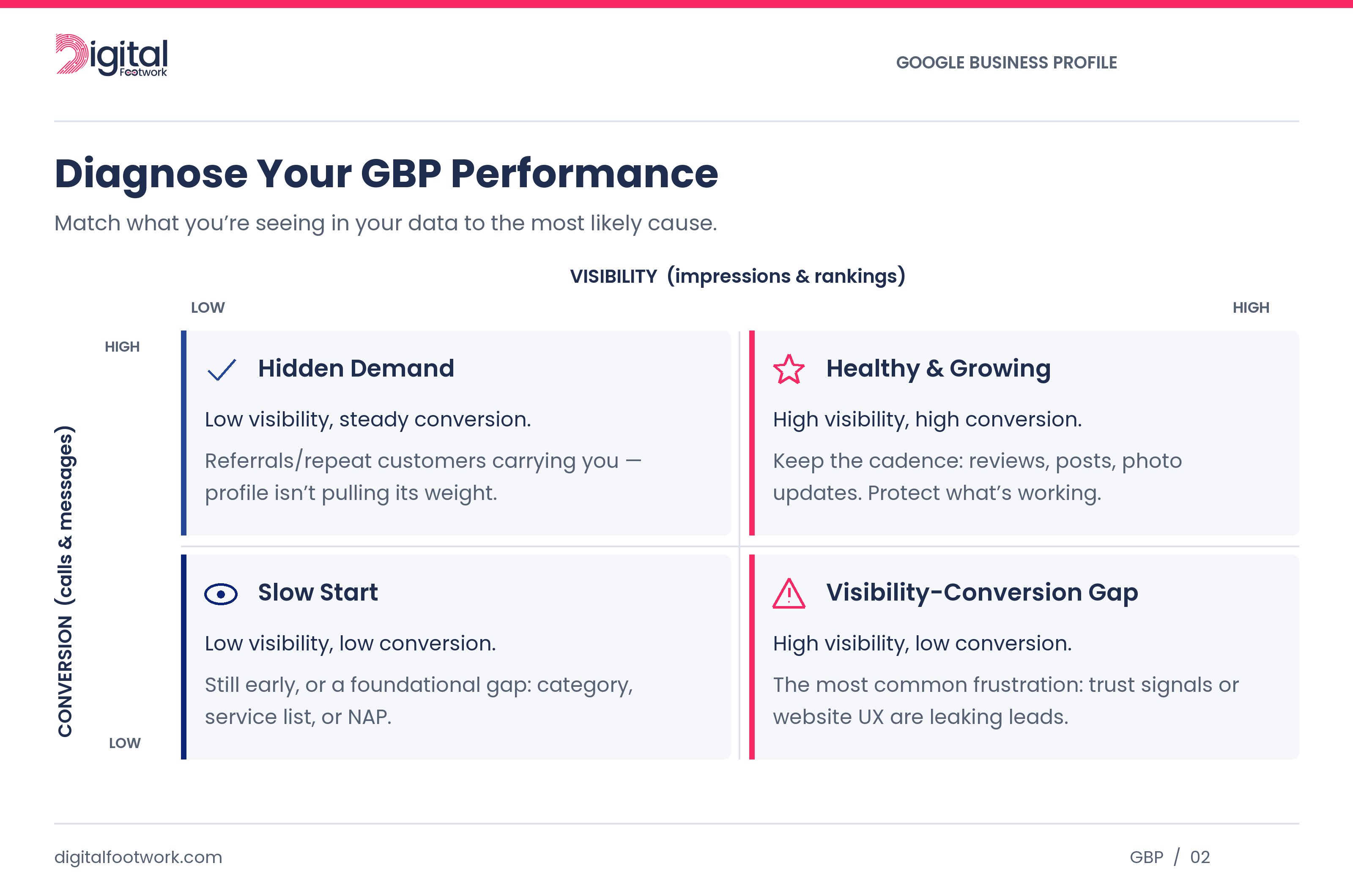
Healthy & Growing — high visibility, high conversion
Both sides of the equation are working. The move here isn't to overhaul anything, it's to protect the cadence that got you here: steady reviews, regular photo updates, and posts that keep the profile active.
Slow Start — low visibility, low conversion
You're either still early in the timeline described above, or there's a foundational gap, an inaccurate category, a thin service list, or inconsistent business information across the web. Start with the fundamentals before adding anything new.
Visibility-Conversion Gap — high visibility, low conversion
This is the most common frustration, and usually the one that prompted this article in the first place. Google is showing your profile; something after that isn't closing the loop, stale reviews, a confusing website, a missing click-to-call button, or a mismatch between what people expect and what they find. If you've worked through the fixes above and this gap persists, it's often worth a structured second look — Google Business Profile optimization and local SEO services built specifically to find this kind of leak can usually spot in an hour what takes a business owner weeks of guessing.
Hidden Demand — low visibility, steady conversion
Referrals and repeat customers are carrying the business while the profile itself isn't pulling much weight. This is a good problem to have and an underused opportunity: the conversion mechanics already work, so investment in visibility (categories, citations, reviews) tends to pay off quickly here.
When You Should Actually Worry
There's no single rule — like "zero calls after exactly 60 days means something's wrong" — that applies to every business; timelines vary too much by market and category for that kind of shortcut to be reliable. Instead, look for patterns across multiple metrics at once. Genuine concern is warranted when several of the following show up together, not just one:
- Visibility (impressions, views) is declining consistently over several weeks, not just fluctuating
- Rankings have dropped substantially for priority terms and haven't recovered
- Website traffic from local/organic search is declining alongside GBP metrics
- Calls and other conversion actions (clicks, direction requests, messages) are all trending down together
- You notice inaccurate or auto-changed business information you didn't authorize
- Categories look off, outdated, or were changed without your knowledge
- There are unresolved verification issues or a restriction/suspension notice on the account
- Competitors are consistently and increasingly outperforming you on the same search terms
One of these alone is often just noise. Several together, sustained over weeks rather than days, is a legitimate signal to dig deeper, and this is precisely the scenario covered in more depth in why GBP calls can drop suddenly even without a suspension, for businesses where the visibility itself, not just the conversion rate, appears to be the issue.
Common GBP Mistakes That Quietly Suppress Calls
- Category creep— adding secondary categories that don't reflect real services, diluting relevance instead of strengthening it
- Stale photos— a gallery untouched in a year reads as inactive, to both Google and searchers
- Service list drift— services on the website that don't match services listed on the profile
- Inconsistent NAP— even small variations in business name, address, or phone number across directories create confusion
- Ignoring the Q&A section— unanswered questions sit indefinitely and often contain exactly what a buyer wanted to know before calling
- Chasing keyword-stuffed business names— against Google's guidelines, and a common trigger for edit rejections or profile review
Frequently Asked Questions
How long does Google Business Profile optimization take to work?
There's no official Google timeline. Edits are typically reviewed within minutes but can take up to 30 days in some cases. Ranking and call improvements usually take longer — early signals often appear within a few weeks, with a clearer picture forming around the 60–90 day mark, though competitive markets can take considerably longer.
Why did my Google Business Profile ranking drop after I optimized it?
Short-term fluctuation is common while Google re-evaluates your profile against search queries. It's not automatically a sign of a mistake. If a drop is substantial and holds for several weeks without recovering, it's worth investigating for a specific cause.
Why am I getting Google Business Profile views but no calls?
Usually something between "profile viewed" and "customer calls" isn't closing the gap: outdated photos, thin or old reviews, unclear service information, a confusing website, or a slow mobile experience. It can also mean the traffic includes informational searchers who weren't ready to hire yet.
Does completing a Google Business Profile guarantee better rankings?
No. A complete, accurate profile improves relevance, one of three factors Google names for local ranking alongside distance and prominence. It doesn't offset distance from the searcher, and it only partially builds prominence, which depends heavily on reviews, citations, and reputation built over time.
Why are my Google Maps calls decreasing even though nothing changed?
Possible causes include normal algorithmic fluctuation, a competitor's recent improvements, seasonal demand shifts, a technical issue with your call-tracking number, or an unnoticed change to your profile. Check your GBP edit history and performance data before assuming the worst.
Can fake or incentivized reviews fix a slow-calls problem?
No, and attempting it can make things worse. Google actively enforces against incentivized and fake reviews and can restrict a profile's ability to receive or display reviews if it detects violations. Building authentic reviews through consistent, unbiased requests is the only sustainable approach.
When should I actually be worried about my GBP performance?
When multiple metrics — visibility, rankings, website traffic, and conversion actions — are declining together over a sustained period, not just fluctuating day to day. A single slow week rarely means anything on its own.
What's the difference between local SEO and Google Business Profile optimization?
GBP optimization is one component of local SEO, focused specifically on your Google listing. Local SEO is broader — it also includes your website's local relevance, citations across other directories, local link building, and overall online reputation, all of which influence how your GBP performs.
The Bottom Line
A quiet phone right after optimizing your Google Business Profile is common, and it's rarely a sign that something is broken. Google needs time to process and evaluate changes, rankings can move around before they settle, and visibility and phone calls are related but distinct outcomes. The businesses that navigate this stage well are the ones tracking the right metrics, giving the process a realistic runway, and troubleshooting specific, identifiable issues, not the ones refreshing their call log every hour looking for reassurance.
If you've gone through a genuine optimization effort and you're still seeing flat or declining performance across multiple metrics after a reasonable evaluation window, that's the point where a deeper audit makes sense. Sometimes the issue is a single overlooked setting. Sometimes it's a combination of profile, website, and reputation factors compounding on each other.
Want a second opinion on your Google Business Profile? Get in touch with Digital Footwork for a profile evaluation and find out whether your current results are genuinely on track or worth addressing now.